
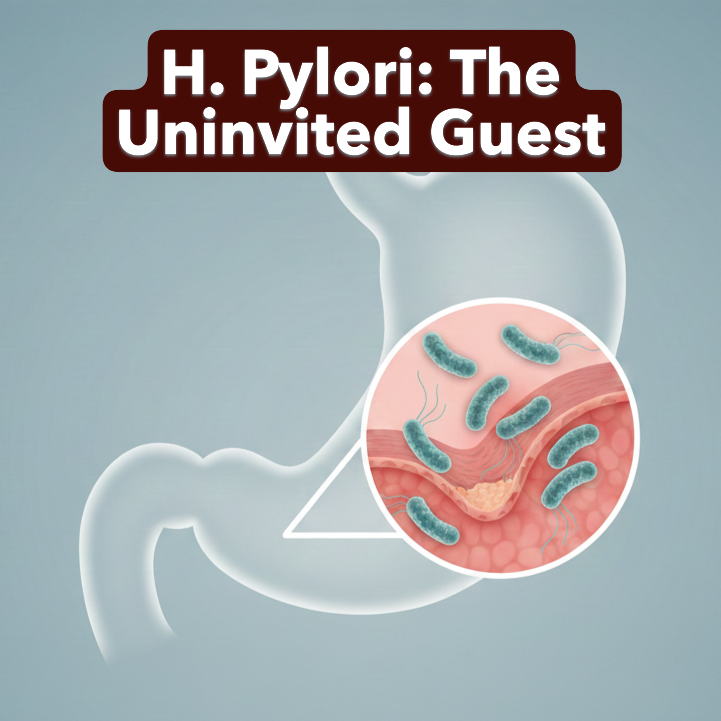
If you’ve ever felt a persistent gnaw in your upper stomach or struggled with recurring indigestion, you might be playing host to one of the most successful biological hitchhikers in human history: Helicobacter pylori (H. pylori). Nearly half of the world’s population is infected with this spiral-shaped bacterium. While it’s been with us for millennia, it wasn’t until the early 1980s that we realized this single organism is the primary driver behind most stomach ulcers and a leading risk factor for gastric cancer. As a gastroenterologist, I find H. pylori fascinating because it is a master of survival. It has evolved to thrive in the highly acidic, “caustic” environment of the human stomach—an environment that would kill almost any other bacteria instantly. But for patients, it’s less of a marvel and more of a mystery.
How Did It Get There? The Mystery of Transmission
One of the most common questions I get is: “Doc, how did I even catch this?”
The truth is, we are still refining our understanding of exactly how H. pylori spreads, but we know it’s primarily a “person-to-person” story.
- The Fecal-Oral Route: This is the most common pathway. It often happens through contaminated food or water, or poor hand hygiene.
- The Oral-Oral Route: The bacteria can be found in saliva or vomitus. This is why we often see “intrafamilial” spread—it’s very common for multiple members of the same household to test positive.
- Early Childhood Acquisition: Most people actually pick up the infection during childhood. Factors like socioeconomic status and living in close quarters play a significant role in how easily it spreads during those early years.
The Silent Resident: Risks and Clinical Manifestations
Here is the tricky part: Most people with H. pylori have no symptoms at all. You could live decades without knowing it’s there. However, just because it’s “silent” doesn’t mean it’s idle.
All infected individuals develop chronic gastritis (inflammation of the stomach lining), even if they don’t feel it. For about 10–15% of people, this inflammation progresses into more serious territory:
- Peptic Ulcer Disease: H. pylori is responsible for about 90% of duodenal ulcers. It weakens the protective mucus coating of the stomach, allowing acid to create an open sore.
- Gastric Cancer: The World Health Organization classifies H. pylori as a Group I Carcinogen. It is the leading cause of gastric adenocarcinoma and MALT lymphoma.
- Nutrient Deficiencies: Interestingly, chronic infection can interfere with how you absorb vital nutrients, leading to Iron Deficiency Anemia and Vitamin B12 deficiency.
If you do have symptoms, they usually manifest as dyspepsia—that classic upper abdominal pain, bloating, or feeling full shortly after starting a meal.
The “Virulence” Factor: Why Some Get Sick and Others Don’t
Why does one person with H. pylori live to 90 with no issues, while another develops an ulcer in their 30s? It comes down to the “virulence” of the specific strain. Some strains carry specific genes, like CagA and VacA, which act like biological weapons, causing more significant damage to the stomach’s cellular structure. Your own genetic inflammatory response also dictates how “angry” your stomach gets in response to the intruder.
Unresolved Mysteries: The Double-Edged Sword?
Science is rarely black and white. While we generally want to eradicate H. pylori once we find it (especially in the presence of symptoms or family history of cancer), there are some “mysteries” still being explored. Some studies suggest that the presence of H. pylori might actually be protective against certain conditions like asthma or acid reflux (GERD). It’s a reminder that our microbiome is a complex ecosystem. However, when we weigh those potential “benefits” against the definitive risk of stomach cancer and ulcers, the medical consensus remains clear: detection and treatment are key.
The Bottom Line
H. pylori isn’t a death sentence, but it is a resident that requires a watchful eye. If you have a history of ulcers, a family history of stomach cancer, or persistent “indigestion” that won’t go away, it’s worth a conversation with your doctor. We have excellent breath, stool, and endoscopic tests to find it—and effective antibiotic regimens to send this uninvited guest packing.
References
- ACG Clinical Guideline: Treatment of Helicobacter Pylori Infection. Chey WD, Howden CW, Moss SF, et al. The American Journal of Gastroenterology. 2024;119(9):1730-1753. doi:10.14309/ajg.0000000000002968.
- Transmission Routes and Patterns of Helicobacter Pylori. Duan M, Li Y, Liu J, et al. Helicobacter. 2023;28(1):e12945. doi:10.1111/hel.12945.
- Epidemiology, Diagnosis and Risk Factors of Helicobacter Pylori Infection. Kotilea K, Bontems P, Touati E. Advances in Experimental Medicine and Biology. 2019;1149:17-33. doi:10.1007/5584_2019_357.
- Helicobacter pylori Infection. Crowe SE. The New England Journal of Medicine. 2019;380(12):1158-1165. doi:10.1056/NEJMcp1710945.
- Helicobacter Pylori Infection in Humans and Phytotherapy, Probiotics, and Emerging Therapeutic Interventions: A Review. Liu M, Gao H, Miao J, et al. Frontiers in Microbiology. 2023;14:1330029. doi:10.3389/fmicb.2023.1330029.
- An Overview of Helicobacter Pylori Infection. FitzGerald R, Smith SM. Methods in Molecular Biology (Clifton, N.J.). 2021;2283:1-14. doi:10.1007/978-1-0716-1302-3_1.